
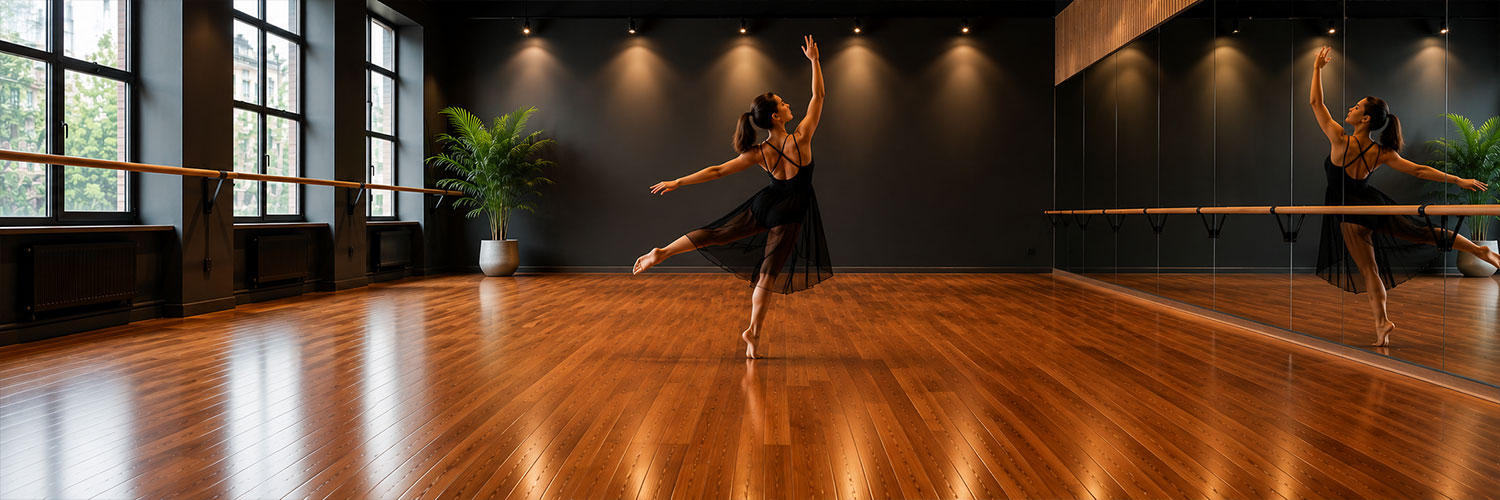
The best wood floor for dance studio facilities is a high-grade Hard Maple or White Oak surface installed over a dual-density elastomer sprung subfloor system. This combination delivers optimal shock absorption (minimum 53% force reduction), precise surface friction, exceptional acoustic control, and unmatched impact resistance required for high-intensity athletic performance.
When designing or upgrading a dance academy, the flooring surface is far more than an aesthetic background—it is an active biomechanical instrument. A substandard floor reflects kinetic energy directly back into the dancers’ ankles, knees, shins, and spine, leading to chronic stress fractures, joint inflammation, and early career fatigue. Conversely, an overly soft or non-resilient floor deadens acoustic feedback and drains dancer energy.
Choosing the right dance studio wood flooring requires balancing biomechanical elasticity, wood grain density, tensile strength, ambient moisture resistance, and long-term wear resistance. Whether you are establishing a classical ballet conservatory, a high-impact tap dance workshop, an energetic hip-hop studio, or an Indian classical dance academy (Kathak/Bharatanatyam), selecting the correct wood species and subfloor construction is essential to safeguard artist wellness and ensure commercial durability.
In this comprehensive buying guide, Kingsmen Enterprises Bengaluru shares architectural hardwood expertise to walk you through subfloor engineering, timber selection, surface finishing, climate adaptation, and long-term maintenance protocols.
The Biomechanical & Architectural Pillars of Dance Flooring
Professional dance floors must balance five architectural criteria: energy shock absorption, controlled slip resistance, high impact resistance, tailored acoustic performance, and dimensional moisture resistance. Without integrating all five pillars, a floor will compromise dancer safety or suffer premature structural failure.
1. Shock Absorption & Force Reduction
Dance places immense peak load forces on the human skeletal system—jumps and leaps generate ground impact forces equivalent to three to five times a dancer’s body weight. Shock absorption measures a flooring system’s ability to dampen kinetic shock upon impact. According to international standards (EN 14904 / DIN 18032-2), commercial dance flooring must achieve a force reduction rating between 53% and 65%. Floors below 50% force reduction transmit excessive kinetic energy into joints, while floors exceeding 70% create excessive trampoline deformation that destabilizes ankles during landing.
2. Slip Resistance & Surface Friction
The coefficient of friction on a dance surface must balance slide and traction. A surface that is too slippery causes falls and pull injuries, while a surface with excessive traction traps pivot points, causing torn ligaments (ACL/MCL) and meniscus damage. Professional dance studio flooring requires a controlled slip resistance rating between 80 and 110 on the Pendulum Test (or a friction coefficient of 0.4 to 0.6 µ). This provides enough traction for sharp directional shifts while allowing smooth pivots and slides.
3. Impact Resistance & Wear Layer Depth
Dancers wear specialized footwear—from tap shoes with metallic sound plates to high-heeled character shoes and heavy street boots. A dense wear layer prevents surface indentation, micro-fracturing, and splintering. Solid hardwood planks (18mm to 22mm thick) or engineered boards with a high-density top veneer (minimum 4mm to 6mm) provide the impact resistance necessary to withstand thousands of hours of high-impact footwear and repeated sanding cycles over decades.
4. Acoustic Performance & Sound Resonance
Acoustics are vital for rhythm-based dance forms like tap, flamenco, and Kathak, where the floor functions as a percussion instrument. Acoustic performance relies on wood density and subfloor cavity acoustics. Dense closed-grain species like maple yield crisp, clear, high-frequency sound, while open-cell systems without acoustic dampening underlayment create unwanted hollow echo and sound bleed into adjacent rooms.
5. Moisture Resistance & Dimensional Stability
Wood is a natural hygroscopic material that absorbs and releases ambient moisture. In climates with seasonal humidity shifts, uncontrolled moisture leads to cupping, crowning, gaps, and buckling. Achieving dimensional stability requires kiln-dried timber (8%–10% equilibrium moisture content), heavy-duty vapor barriers, and quarter-sawn or multi-ply engineered construction techniques.
Subfloor Infrastructure: Why Sprung Dance Floors Are Non-Negotiable
Installing hardwood flooring for dance studio setups directly onto rigid concrete carries a significant risk of chronic injury over time. A true sprung dance floor uses a suspended, shock-absorbing understructure that flexes under weight to cushion impacts, return energy, and protect dancer health.
Types of Sprung Subfloor Systems
- Dual-Density Elastomer Block Systems: These floating subfloor configurations use specialized rubber or polyurethane pads attached to double-layer plywood subflooring. The outer layer absorbs light impact (such as pointework or child dancers), while the dense core engages under heavier loads (such as adult leaps and group jumps) to prevent bottoming out.
- Basketweave Sprung Subfloors: A traditional, highly responsive floating system made from interlaced sleeper strips laid in criss-cross layers with rubber cushions underneath. Basketweave systems offer consistent flex across the entire room, eliminating hard dead spots near walls or seams.
- Batten & Cushion Systems: Parallel hardwood or plywood battens are fitted with resilient continuous foam strips or spaced elastomer blocks. This design provides excellent air circulation, consistent vertical deflection, and simple height adjustments over uneven concrete slabs.
Standard residential foam underlays or standard carpet padding lack the structural memory and load capacity required for athletic dance activities, degrading quickly under repeated point loads and resulting in uneven surfaces.
Hardwood Species & Construction Comparison: Solid vs Engineered Wood
For heavy commercial dance studios, Hard Canadian Maple and Premium White Oak represent two of the most reliable timber choices available. While solid hardwood offers long life through multiple re-sanding cycles, high-grade engineered hardwood with a thick real-wood wear layer provides superior dimensional stability in areas subject to fluctuating humidity or ambient temperatures.
Comparing Key Hardwood Species
- Canadian Hard Maple (Janka Hardness: ~1,450 lbf): Light cream color, fine closed grain, uniform appearance. Highly resistant to splintering, abrasion, and shoe scuffs. Ideal for multipurpose dance spaces, ballet, contemporary, and high-impact tap.
- European White Oak (Janka Hardness: ~1,360 lbf): Distinctive open grain, rich natural amber-brown tones. High shock resistance, excellent stability, hides micro-scratches. Ideal for commercial dance schools, ballroom, hip-hop, and multi-use performance halls.
- Teak & Merbau (Janka Hardness: 1,150 – 1,920 lbf): Tropical hardwoods with rich natural oils, warm deep colors, and high natural moisture tolerance. Exceptional stability under varying indoor humidity; dense grain withstands heavy wear. Ideal for boutique studios, Indian classical dance, and multi-functional spaces requiring high moisture tolerance.
Solid Hardwood vs. Engineered Wood Flooring
- Solid Hardwood: Provides an uninterrupted 18mm to 22mm timber thickness that can be sanded and refinished multiple times over decades. However, solid planks expand and contract significantly with changes in ambient humidity, requiring controlled indoor environments.
- Engineered Hardwood: Built with a top real-wood wear layer (4mm–6mm) fused to a cross-laminated Baltic Birch plywood core. This cross-directional construction resists expansion, warping, and cupping caused by environmental moisture, making engineered wood flooring a practical choice over concrete slabs and in high-humidity regions.
Flooring Recommendations by Dance Style
Different dance styles place unique demands on floor surfaces. Tap requires acoustic clarity and high dent resistance, ballet demands slip resistance and spring, hip-hop calls for impact resistance, and Indian classical dance requires smooth, splinter-free surfaces for barefoot movement.
- Classical Ballet & Pointe: Requires controlled lateral friction to prevent slips, along with high force reduction to protect joints during leaps. Recommended System: Sprung Maple or Sprung Oak finished with a low-friction satin seal or vinyl Marley overlay.
- Tap, Flamenco & Percussive Styles: Tap dancers strike the floor with metal taps, generating concentrated point loads and high-frequency acoustic vibrations. Recommended System: Unfinished or thin-coated 18mm Solid Canadian Maple over a dense sprung subfloor for bright acoustics without splintering.
- Contemporary, Jazz & Modern Dance: Involves floor work where dancers are in direct contact with the surface using bare feet or socks. Recommended System: Smooth, closed-grain Hard Maple or Oak treated with a silk-satin water-borne polyurethane finish to protect skin from abrasions.
- Hip-Hop, Urban & Street Dance: Heavy athletic footwear, high-impact jumps, and floor tricks require extra toughness and shock dampening. Recommended System: Engineered White Oak or dense Maple on a heavy-duty dual-density elastomer sprung base.
- Indian Classical Dance (Kathak & Bharatanatyam): Kathak features fast footwork (Tatkkar) with ankle bells (Ghungroo), while Bharatanatyam relies on rhythmic stamping (Adatau). Dancers perform barefoot, requiring a smooth, warm, splinter-free surface. Recommended System: Fine-grained Burma Teak, Maple, or Smooth Oak on a sprung subfloor free of exposed fasteners or uneven finish seams.
- Ballroom & Social Partner Dancing: Dancers wear leather-soled shoes and perform long glides, spins, and turns across wide areas. Recommended System: Solid Oak, Maple, or Teak strip flooring with a smooth coat finish that provides a controlled glide.
Navigating Indian Climate & Environmental Conditions
Installing a wooden flooring for dance studio projects in Indian cities like Bengaluru requires managing humidity shifts between monsoon season and drier months. Without perimeter expansion gaps, moisture barriers, and controlled wood drying, solid timber floors can expand, warp, or buckle.
- Kiln Drying & Moisture Calibration: Hardwood must be kiln-dried to an equilibrium moisture content (EMC) of 8%–10% prior to installation to ensure structural stability through seasonal weather shifts.
- Sub-Slab Vapor Barriers: Concrete ground slabs absorb ground moisture. Laying a heavy-duty 200-micron polyethylene vapor barrier beneath the sprung subfloor blocks rising damp and prevents structural warping.
- Perimeter Expansion Joints: Hardwood naturally expands as relative humidity rises. Leaving a 15mm to 20mm expansion gap along all perimeter walls hidden beneath breathable skirting boards allows the floor to flex naturally without buckling.
- Engineered Hardwood for High-Humidity Regions: In coastal or monsoon-heavy locations, engineered hardwood offers superior structural stability compared to solid timber, reducing the likelihood of gaps and board crowning.
Comprehensive Dance Flooring Material Comparison
Solid maple on a sprung subfloor provides the best long-term durability and acoustic feedback. Engineered oak offers superior stability in humid environments. Standard residential laminates or unyielding surfaces like raw concrete lack the structural resilience needed for athletic performance spaces.
- Solid Maple (18mm): Excellent shock absorption (with sprung subfloor), 40–50+ years lifespan, refinishable up to 10 times. Ideal for premium multi-purpose dance studios.
- Solid White Oak (18mm): Excellent shock absorption (with sprung subfloor), 35–50 years lifespan, hides micro-scratches effectively. Ideal for heavy commercial wear.
- Engineered Oak (6mm Wear Layer): Excellent shock absorption (with sprung subfloor), 20–30 years lifespan, high moisture resistance. Ideal for high-humidity or ground-floor applications.
- Vinyl Marley over Wood: Low to medium shock absorption, 5–10 years lifespan, excellent surface traction. Ideal as a ballet overlay system.
- Standard Laminate: Minimal shock absorption, short commercial lifespan, unrepairable upon surface damage. Not suited for professional dance use.
Common Installation & Material Mistakes to Avoid
Proper planning during installation prevents costly structural issues later. Three common oversights in studio flooring include anchoring hardwood directly onto concrete, using standard non-sprung residential underlayments, and applying high-gloss polyurethane finishes that reduce traction.
- Installing Directly Over Concrete: Attaching wood directly to a concrete slab creates an unyielding surface that transmits impact forces back into dancers’ joints, accelerating physical fatigue.
- Applying High-Gloss Commercial Varnish: Standard high-gloss polyurethane lacquers create a slick surface that increases the risk of slipping. Use specialist anti-slip water-borne polyurethane finishes tested to athletic friction standards.
- Skipping Subfloor Ventilation: Enclosing a sprung subfloor without perimeter ventilation traps ambient humidity underneath, encouraging wood rot, mold growth, and subfloor failure over time.
- Inadequate Wood Acclimatization: Installing hardwood boards immediately after delivery without allowing them to adjust to the studio’s indoor climate for 5 to 7 days can lead to post-installation shrinkage or expansion.
Maintenance & Refinishing Protocol for Maximum Lifespan
To maintain a dance floor in optimal condition, perform daily dry microfiber sweeping, wet-mop weekly with a pH-neutral cleaner, apply a fresh anti-slip top coat every 2–3 years, and plan for a dustless deep sanding every 10–12 years.
Daily and Weekly Care Protocols
- Dry Dusting: Sweep daily using an industrial microfiber dust mop to collect fine grit, dirt, and dust that act like abrasives under dance shoes.
- Moisture-Controlled Damp Mopping: Clean weekly with a well-wrung microfiber flat mop and a specialized pH-neutral sport cleaner. Flooding wood floors with standing water or steam mops should be strictly avoided.
- Strict Footwear Rules: Prevent street shoes, spike heels, and outdoor footwear from entering the dance space by positioning entry mats and shoe storage outside studio doors.
Long-Term Surface Screening & Sanding
- Screening and Recoating (Every 2–3 Years): Lightly abrade the top finish coat using a fine-grit sanding pad to remove micro-scratches, then apply a fresh layer of anti-slip water-borne polyurethane. This restores surface friction and protects the wood underneath without reducing timber thickness.
- Full Sanding and Restoration (Every 10–15 Years): For solid hardwood or thick-veneered engineered floors, perform a full dustless sanding back to bare wood to eliminate deeper indentations, re-level high spots, and re-apply complete primer and finish coats.
Buyer’s Checklist for Dance Studio Wooden Flooring
Use this pre-purchase checklist to verify that your chosen flooring system meets professional safety, performance, and durability standards:
- Subfloor Architecture: Is the system built on a certified dual-density sprung or floating subfloor?
- Force Reduction: Does the floor achieve a minimum 53% shock absorption rating?
- Timber Grade & Species: Is the surface hardwood First-Grade Hard Maple, European Oak, or Burmese Teak?
- Wear Layer Thickness: If engineered, is the top wear layer at least 4mm to 6mm thick?
- Surface Finish: Is the topcoat an anti-slip, low-VOC water-borne polyurethane designed for dance and sports?
- Moisture Protection: Is a 200-micron vapor barrier membrane included beneath the subfloor?
- Expansion Gaps: Has a 15mm–20mm perimeter expansion gap been incorporated into the layout plan?
- Environmental Certification: Is the timber sourced from FSC-certified sustainable forests?
- Installer Expertise: Is the installation team experienced in specialized sprung dance floor systems?
Kingsmen Enterprises Bengaluru: Your Expert Flooring Partner
Kingsmen Enterprises Bengaluru provides specialized commercial hardwood flooring solutions across South India. They offer custom engineered sprung subfloor systems, premium solid wood supplies, and expert dance floor installation services.
Selecting the right floor for a dance studio requires dedicated hardwood craftsmanship. Based in Hebbal, Bengaluru, Kingsmen Enterprises offers extensive experience supplying high-performance hardwood solutions for dance academies, athletic facilities, luxury residences, and commercial spaces.
Kingsmen Enterprises Technical Capabilities:
- Curated Timber Selection: From Solid Canadian Hard Maple and European White Oak to Burma Teak, Kingsmen Enterprises supplies high-grade hardwoods sourced from certified sustainable forests.
- Custom Sprung Subfloor Fabrication: Kingsmen Enterprises designs floating sprung subfloor systems tailored to specific ceiling heights, facility layouts, and performance requirements.
- Climate-Adapted Installation: Kingsmen Enterprises measures sub-slab moisture levels and calibrates timber moisture content to ensure stability through changing regional weather conditions.
- Comprehensive Installation Services: From initial subfloor preparation to dustless sanding and anti-slip polyurethane application, Kingsmen Enterprises manages every stage of project execution.
Whether establishing a new dance academy or replacing an existing floor, Kingsmen Enterprises Bengaluru provides technical guidance and execution tailored to your space.
Ready to get your flooring right the first time? Contact Kingsmen Enterprises for a consultation and discover how the right timber floor – expertly specified, installed, and maintained- can transform your space for generations.
Call us: +91 7349252501 | +91 9148124943
Email: krishnaraj@kingsmen.in
Frequently Asked Questions
Solid Canadian Hard Maple or European White Oak installed over a dual-density sprung subfloor represents the ideal combination. It offers predictable shock absorption, strong impact resistance, and long-term durability over multiple sanding cycles.