
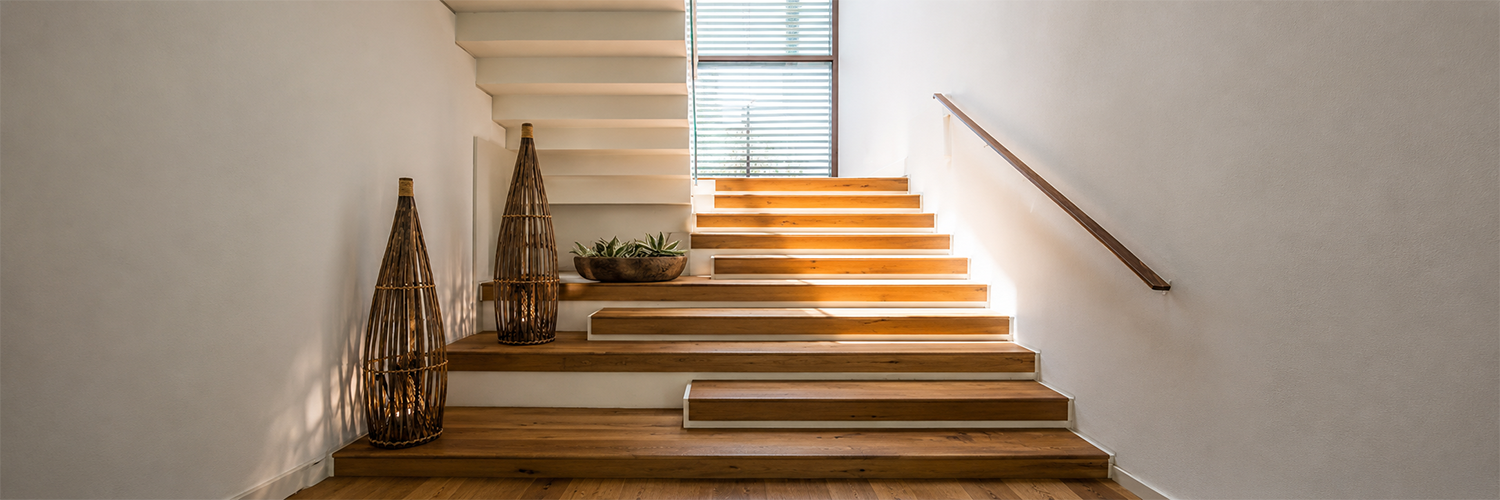
A staircase is one of the hardest-working elements in a home. Unlike flooring, which spreads foot traffic across a large surface, staircase treads absorb concentrated impact in the same spots every single day. Choose the wrong timber and you will see dents, cracks, and surface failure within a few years. Choose the right one and your staircase will outlast almost every other element in the house.
At Kingsmen Enterprises, we have designed and installed hardwood staircases across India, from coastal villas in Kochi and Goa to high-rise apartments in Bengaluru and Hyderabad. Over the years, we have narrowed our offering to three species that consistently deliver the best balance of performance, longevity, and value for Indian homes: Burma Teak, Merbau, and Rubber Wood.
This guide covers everything you need to make the right decision: technical specifications, Janka hardness ratings, price ranges, climate suitability, and an honest side-by-side comparison.
Why Staircase Wood Selection Is Different From Flooring
Most homeowners treat staircase wood the same as flooring wood. It is not the same.
Flooring distributes pressure across a wide area. A staircase tread, typically 10–12 inches deep, receives the full force of each footstep in the same narrow zone, thousands of times a year. The leading edge of each tread (the nosing) is under constant abrasion. This is why species that perform adequately as flooring can show premature wear as staircase treads.
The ideal staircase wood must deliver:
- High Janka hardness to resist denting under concentrated foot traffic
- Dimensional stability so the wood does not shrink, swell, or develop squeaks as humidity changes with Indian seasons
- Natural or treated moisture resistance is particularly important in coastal cities and during monsoon months
- Long-term refinishability, meaning the ability to be sanded and recoated multiple times over decades
- Structural integrity across the full tread depth, not just the surface
With those requirements in mind, here is how our three species compare.
The Technical Comparison: Burma Teak vs Merbau vs Rubber Wood
| Property | Burma Teak | Merbau | Rubber Wood |
| Janka Hardness | 1,070 lbf | 1,712–1,925 lbf | 930–980 lbf |
| Density | 655 kg/m³ | 815 kg/m³ | ~560–650 kg/m³ |
| Natural Moisture Resistance | Excellent (natural oils) | Very Good | Low; needs proper sealing |
| Dimensional Stability | Excellent | Excellent | Good when kiln-dried |
| Termite Resistance | Excellent (heartwood) | Excellent | Low; requires treatment |
| Refinishability | Multiple times over decades | Multiple times | 2–3 times |
| Typical Price (Installed, per sq ft) | ₹900 – ₹1,400+ per sq. ft. | ₹650 – ₹1,000 per sq. ft. | ₹450 – ₹700 per sq. ft. |
| Best Climate | All India, especially coastal | All India, especially high-traffic urban | Controlled indoor environments |
| Ideal For | Luxury homes, coastal properties | Large families, high foot traffic | Modern apartments, urban residences |
* Prices listed are approximate averages per square foot for material, polishing, and standard installation from IndiaMart, Justdial & TradeIndia
What is Janka hardness? The Janka hardness test measures the force required to embed a steel ball halfway into a wood sample. A higher number means the wood is more resistant to denting and surface wear. For reference, common Red Oak (a standard benchmark) rates 1,290 lbf. Burma Teak at 1,070 lbf is comparable to walnut; Merbau at 1,712-1,925 lbf is among the hardest tropical hardwoods available anywhere.
Burma Teak (Sagwan Wood): The Gold Standard for Indian Staircases
Burma Teak, known as Sagwan wood in Hindi, is the species most architects and interior designers in India specify when budget is not the primary constraint. Its reputation has been built over centuries of use in Indian homes, temples, and heritage structures. That reputation is earned.
What Makes Burma Teak Different
The defining characteristic of genuine Burma Teak is its natural oil content. Few other commercially available timbers contain this level of built-in moisture resistance without any chemical treatment. These oils (primarily tectoquinone) reduce moisture absorption, prevent warping during India’s humidity swings, and naturally inhibit termites in the heartwood.
Burma Teak also exhibits extremely low cracking rates over time. In practical terms, out of 100 teak staircase treads installed, only about 3% develop cracks over a normal 20-year lifespan under typical Indian conditions. This is one of the lowest failure rates of any hardwood species used in staircases.
Its Janka hardness of 1,070 lbf is moderate by hardwood standards, but this figure is somewhat misleading. Teak’s real-world performance under foot traffic is significantly better than the raw number suggests, because its natural oils protect the surface from drying out and becoming brittle, which is the main cause of surface degradation in other species.
From a design standpoint, Burma Teak ages beautifully. The initial golden-brown colour deepens and enriches over time, developing a character that other species do not replicate.
Where Burma Teak Works Best in India
Burma Teak is the only species we recommend for coastal homes in cities like Mumbai, Kochi, Chennai, and Goa, where humidity levels remain high year-round. Its natural oils provide protection that no finish coating alone can match over decades.
It also performs exceptionally well in heritage-inspired interiors, luxury villas, bungalows, and any home where the staircase is a focal design element rather than a purely functional one.
Burma Teak Price in India (2026)
Installed Burma Teak staircase treads typically range from ₹900 to ₹1,400+ per sq ft depending on tread thickness, profile complexity, and finish specification. This is the premium tier, but over a 30-40 year lifespan, the per-year cost of ownership is often lower than cheaper alternatives that require more frequent maintenance or replacement.
Honest Limitations
- Higher upfront cost than Merbau and Rubber Wood
- Not the right choice if you specifically want a very dark, near-black tone
- Availability of genuine Grade A Burma Teak (as opposed to plantation teak) requires a trusted supplier, as quality varies significantly in the market
Merbau (Kwila Wood): The Strongest Choice for High-Traffic Indian Homes
If raw hardness and wear resistance are your top priorities, Merbau has no equal among the three species we offer. With a Janka hardness of 1,712–1,925 lbf, Merbau is nearly twice as hard as Burma Teak and roughly 30–80% harder than most domestically popular hardwoods.
It is the species we most frequently recommend for duplex homes, large family homes with children, homes where pets are present, and any staircase expected to handle very heavy, daily foot traffic.
The Technical Case for Merbau
Merbau’s density, averaging 815 kg/m³, is significantly higher than most staircasing timbers. This density translates directly into resistance to the nosing wear that is the most common failure mode in Indian staircases. The leading edge of each tread takes the hardest punishment; Merbau’s hardness means that edge holds its shape far longer.
Merbau also has excellent dimensional stability, comparable to teak, which means it handles India’s seasonal humidity changes well. Its natural deposits of mineral salts and resin make it highly resistant to termites, even in regions where termite pressure is high.
The distinctive reddish-brown colour of aged Merbau, with its characteristic gold flecking in the grain, gives staircases a bold, warm appearance that works particularly well in contemporary and luxury interiors.
Where Merbau Works Best in India
Merbau is the best all-round choice for urban Indian apartments and houses in cities like Bengaluru, Hyderabad, Pune, and Delhi, where indoor conditions are more controlled and the primary concern is durability under heavy daily use rather than coastal humidity.
It is also the species most frequently chosen by homeowners who have had a previous staircase show wear within 5–7 years and want a long-term solution that will not need premature refinishing.
Merbau Price in India (2026)
Installed Merbau staircase treads typically range from ₹650 to ₹1,000 per sq ft, positioning it as a strong mid-to-premium option that delivers close to teak-level performance at a lower initial cost.
Honest Limitations
- The reddish-brown tone does not suit Scandinavian-style or minimalist interiors that call for pale, light-toned wood
- Merbau can bleed yellow water-soluble mineral deposits during installation if exposed to moisture. This requires care during the finishing stage but does not affect the long-term finished staircase
- Harder to work with hand tools due to density, so professional installation is essential
Rubber Wood: The Practical Choice for Modern Urban Homes
Rubber Wood is often underestimated because it is perceived as a budget material. That perception is partly fair and partly outdated. Properly selected and correctly installed Rubber Wood can deliver very good performance in the right context and it remains the most accessible entry point to a solid hardwood staircase.
Understanding Rubber Wood’s Strengths
Rubber Wood (Hevea brasiliensis) is harvested from rubber plantation trees after their latex-producing life ends, making it one of the more sustainable hardwood options available. It has a fine, straight grain and a light, neutral tone, two characteristics that align well with current modern and minimalist interior design trends.
Its Janka hardness of approximately 930–980 lbf is lower than Merbau and slightly lower than Teak, but still significantly above softwoods and engineered alternatives. When properly kiln-dried and finished, it handles normal residential stair traffic adequately.
One of Rubber Wood’s genuine advantages is its workability. It accepts stains and finishes very evenly, allowing colour customisation that is harder to achieve with the stronger-grained Teak and Merbau. If you want a specific stained tone, lighter or darker, Rubber Wood is the most cooperative canvas.
Where Rubber Wood Works Best in India
Rubber Wood is most suitable for modern apartments and urban residences in Bengaluru, Hyderabad, Pune, NCR, and similar cities where indoor humidity is relatively controlled and the staircase sees moderate rather than very heavy foot traffic.
It is a sensible choice for homeowners renovating an apartment, working within a defined budget, and prioritising a clean, contemporary aesthetic over the maximum possible lifespan.
Rubber Wood Price in India (2026)
Installed Rubber Wood staircase treads typically range from ₹450 to ₹700 per sq ft, making it the most accessible of the three species.
Honest Limitations
Rubber Wood has low natural water resistance and is susceptible to moisture and fungal attack if not properly treated and sealed. This makes it unsuitable for coastal properties, homes with open or semi-exposed staircases, or any installation where moisture exposure is a concern.
It also has fewer refinishing opportunities than Teak or Merbau. A Rubber Wood staircase can typically be sanded and recoated 2–3 times over its life; Teak and Merbau can be refinished far more often.
It is not the right choice if you want a 30-year staircase with minimum intervention. It is the right choice if you want a good-looking, cost-effective staircase in a controlled indoor environment.
Solid Wood Stairs vs Engineered Wood Stairs
Homeowners frequently ask whether engineered wood stairs are a viable alternative to solid hardwood. Here is our honest assessment.
Engineered staircase products consist of a thin hardwood veneer bonded over a plywood or composite core. They offer two genuine advantages: lower cost and slightly better dimensional stability in highly variable humidity conditions. For flooring, these trade-offs can make sense.
For staircases, they generally do not. The stair nosing (the most-used part of any tread) wears through the thin veneer relatively quickly, and once that happens, refinishing is not possible. Solid hardwood treads, by contrast, can be sanded down multiple times over decades, effectively renewing the surface each time.
Our recommendation: for any staircase intended to last 20+ years, use solid hardwood. Engineered products may be appropriate for very specific budget-constrained situations, but they are not a like-for-like substitute.
Which Wood Is Right for Your City and Climate?
Coastal Cities: Mumbai, Kochi, Chennai, Goa, Vizag
Recommended: Burma Teak
High year-round humidity is the defining challenge here. Burma Teak’s natural oils provide the only reliable long-term protection against the moisture absorption, joint swelling, and finish degradation that high-humidity environments cause. Neither Merbau nor Rubber Wood can match teak’s passive moisture resistance over decades in these conditions.
Monsoon-Heavy Regions: Kerala, Konkan, North-East India
Recommended: Burma Teak, or Merbau where cost is a factor
Seasonal moisture extremes require maximum dimensional stability. Both Teak and Merbau have proven track records in these conditions. Rubber Wood is not recommended unless the staircase is fully interior and humidity-controlled.
Urban Apartments & Controlled Indoor Environments: Bengaluru, Hyderabad, Pune, Delhi, Noida
Recommended: Merbau for high-traffic homes, Rubber Wood for moderate-traffic modern interiors
Controlled indoor environments reduce the moisture risk, shifting the primary decision criteria to hardness, aesthetics, and budget. Merbau wins on pure durability; Rubber Wood offers the best value for lighter-use modern spaces.
Heritage Homes, Luxury Villas, Bungalows: Pan-India
Recommended: Burma Teak
Where the staircase is an architectural centrepiece and longevity is the primary value, Burma Teak is the definitive choice.
How Long Will Each Wood Last? Realistic Lifespan Expectations
| Species | Expected Lifespan (Properly Installed & Maintained) | Refinishing Potential |
| Burma Teak | 40–60+ years | 5–8 full refinishes |
| Merbau | 25–40 years | 4–6 full refinishes |
| Rubber Wood | 12–20 years | 2–3 light refinishes |
These figures assume professional installation, correct moisture conditioning before fitting, and basic annual maintenance. A poorly installed teak staircase will underperform a well-installed Merbau one; timber quality and craftsmanship matter as much as species selection.
Staircase Maintenance Tips That Apply to All Three Species
Sweep or dust regularly. Fine grit particles act as abrasives under foot traffic. Regular cleaning is the cheapest and most effective form of staircase protection.
Wipe up liquid spills immediately. All three species, including teak, can suffer localised finish damage from standing water.
Use recommended cleaning products. Avoid harsh acidic or alkaline cleaners. A mild wood-specific cleaner is sufficient for all three species.
Inspect the nosing annually. The leading edge of each tread is where wear first appears. Early identification lets you refinish before the damage reaches the wood substrate.
Refinish before the finish fails, not after. Re-coating a staircase in good condition is straightforward. Refinishing a staircase with bare wood exposure, deep scratches, or water staining is significantly more work and cost.
Why Homeowners Across India Choose Kingsmen Enterprises
A staircase is only as good as the combination of material quality, correct moisture conditioning, and installation precision behind it. We have seen high-quality timber underperform because it was not properly acclimatised before installation, and we have seen well-installed Rubber Wood staircases look excellent after 15 years in the right environment.
At Kingsmen Enterprises, we supply Burma Teak, Merbau, and Rubber Wood staircases specifically specified and installed for Indian climatic conditions. Our process includes timber selection, correct pre-installation moisture conditioning, precise tread fitting, and finish application. All of these are critical steps that determine how long a staircase actually lasts.
We supply and install across India. To discuss your project and receive a quotation, contact us directly.
Frequently Asked Questions
Burma Teak is widely considered the best choice for Indian staircases because it combines natural moisture resistance, long lifespan, and low maintenance requirements. Merbau is the better choice where maximum hardness and durability under heavy foot traffic is the priority, and Rubber Wood is the most practical option for modern urban apartments on a tighter budget.